






Your dispatcher books the loads — and never sees the logs.
You run trucks. We run everything else.
FLX Trucking is a truck dispatch service for small and mid-size fleets across the US.
No contract No setup fee One invoice, not four
Our partners
The companies and services that trust us with their clients.
FLX Trucking partners: TT ELD, Quantum, FIVE ELD, Safety Management, Aaron Safety, DOT Compliance.
Sounds familiar
Four vendors. Four invoices. Four people pointing at each other.
Your ELD provider owns the hours — and never sees the freight.
Your safety company files the paperwork — and finds out weeks later.
Your bookkeeper invoices the loads — including the one that fell through.
None of them see the other three. You do — four phone calls at a time.
What we do
Dispatch, ELD, safety, accounting. Under one roof.
Truck dispatch
Load booking and rate negotiation on both Amazon Relay and the broker load boards. You decide which one your trucks run on — and if that market goes dead, we can move them to the other until it comes back. Every broker gets vetted and credit-checked, with rate confirmations, lane planning and check calls handled so your driver only drives.
DOT safety compliance
FMCSA and DOT compliance handled in-house: driver qualification files, the drug and alcohol program, roadside inspection follow-up, CSA score monitoring, and audit prep — so a violation gets answered the week it happens, not the month after.
ELD services
ELD hardware, setup, and daily log monitoring under the FMCSA ELD mandate. We watch hours of service across the fleet every day and flag a driver before he runs out of clock, so an HOS violation never reaches your safety score.
Trucking accounting
Bookkeeping built for carriers: load invoicing, driver settlements, fuel and expense tracking, quarterly IFTA filing, and books your CPA can actually use in January instead of rebuilding from a shoebox.
Amazon Relay — RPM we target
$3.00+
per mile
Dispatch, ELD, safety, and books — none of them bill on a truck that didn't roll.
Side by side
Four services. Or one.
The same four jobs get done either way. What changes is how many people you have to manage.
Services to manage
FourFour services
OneFLX
Invoices a month
Four, on four datesFour services
OneFLX
When something breaks
Four numbers to callFour services
Your managerFLX
Do they see each other's work
No — you relay itFour services
Same officeFLX
Who chases the paperwork
You, between the fourFour services
We doFLX
Where the week gets reviewed
NowhereFour services
A call, every weekFLX
Proof, not promises
Real fleets. Real weeks. Real numbers.
These aren't projections. These are actual gross screenshots from the trucks we run.
Show me the numbers for
Weekly gross
Solo$21,192.18
Miles
5,157.93 mi
RPM
$4.11/mi
On-time
96.88%
Weekly gross
Solo$14,289
Miles
4,316.2 mi
RPM
$3.31/mi
On-time
90.00%
Weekly gross
Solo$12,941.28
Miles
3,687.58 mi
RPM
$3.51/mi
On-time
68.18%
Weekly gross
Solo$17,341.63
Miles
6,003.99 mi
RPM
$2.89/mi
On-time
100.00%
Weekly gross
Solo$15,127.12
Miles
4,882.69 mi
RPM
$3.10/mi
On-time
100.00%
Weekly gross
Solo$18,308.42
Miles
6,105.6 mi
RPM
$3.00/mi
On-time
94.44%
Weekly gross
Team$17,004.58
Miles
4,744.81 mi
RPM
$3.58/mi
On-time
85.00%
Weekly gross
Team$26,896.36
Miles
6,536.99 mi
RPM
$4.11/mi
On-time
92.31%
Weekly gross
Team$22,411
Miles
5,339.75 mi
RPM
$4.20/mi
On-time
76.12%
How it works
From the first call to a dispatched fleet.
Five steps. None of them takes a truck off the road.
01
Call
Fifteen minutes with Alby. Your fleet, your lanes, and what isn't working right now.
02
Setup
We take the paperwork over — carrier packets, ELD, safety files, books. The trucks keep running.
03
First loads
Your dispatcher starts booking on Amazon Relay and the broker load boards, on your lanes.
04
Weekly review
Your manager builds the report and walks you through it, truck by truck. Every week.
05
Growth
Add a truck and nothing else changes: same manager, same office, still one invoice.
Weekly review
Your manager. Same person, every week.
Before every call he builds this report for your fleet: gross, loads, RPM, miles, the day-by-day trend, your top lanes, and how each truck performed.
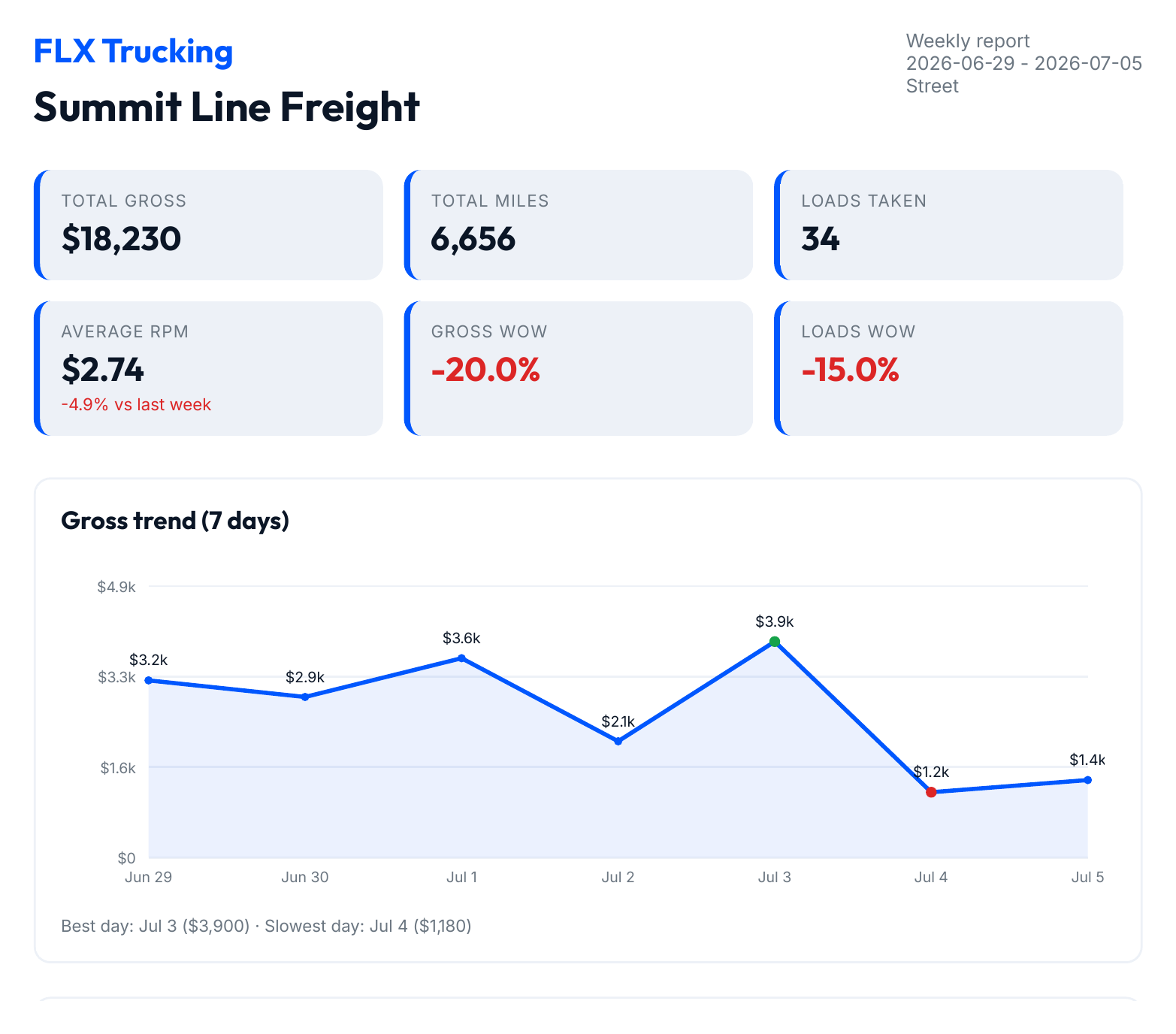
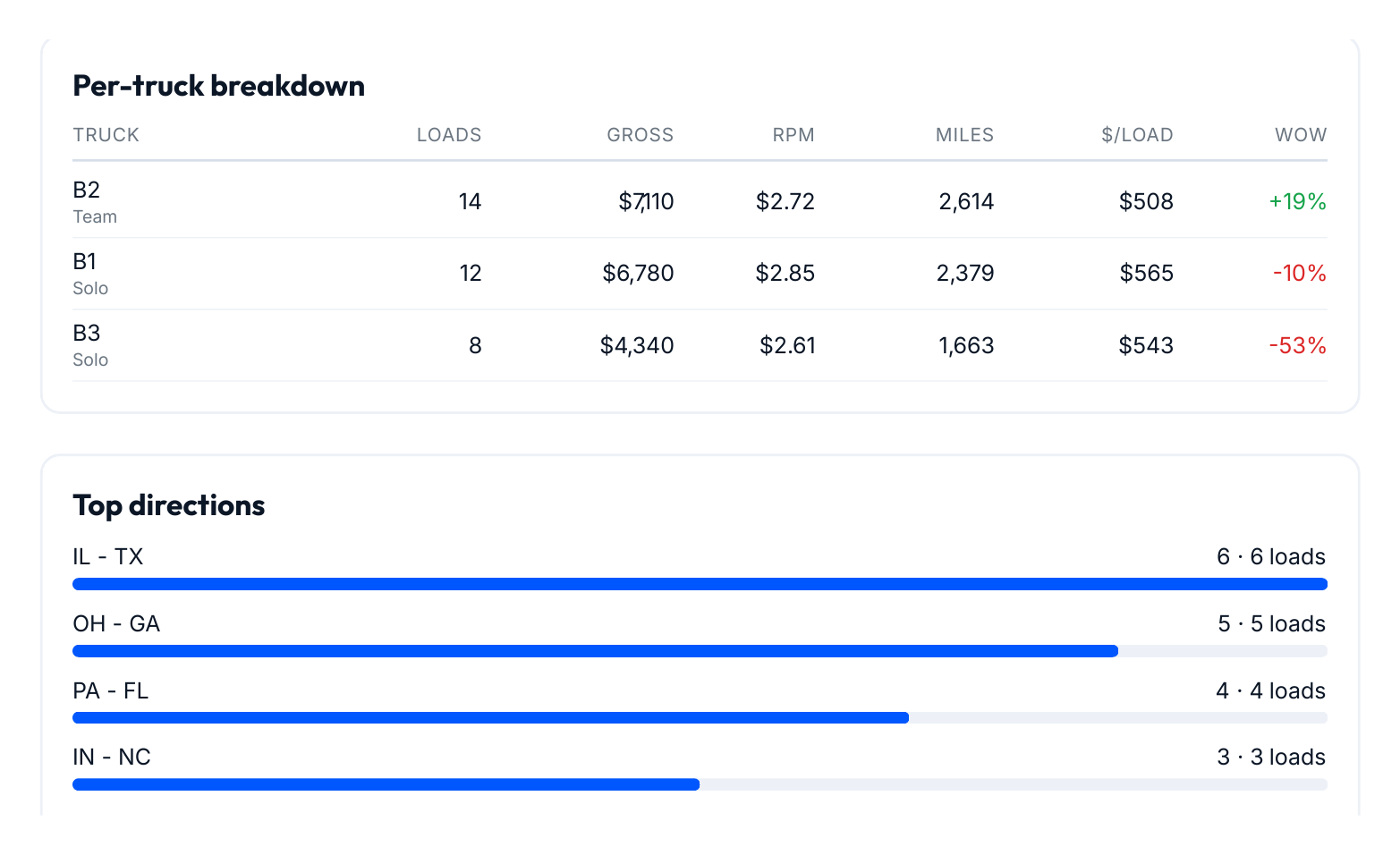
Then you go through it together, truck by truck.
01
What happened.
The week in numbers, day by day. Not from memory — on the screen.
02
Why it happened.
A slow day. A soft lane. A truck that ran below the rest. If something went wrong, you'll see exactly what — and exactly why.
03
What we do about it.
Every call ends with a plan for next week. What we change. What we push. What we drop.
Look closer at the report above. That's a down week — gross fell 20% from the week before. We could have shown you a perfect one. We didn't. We send the bad weeks the same as the good ones, with the reason attached and a plan for the next one.
The three things carriers actually worry about
You are not worried about features. You are worried about these.
So we answer them before you have to ask.
01
Communication
"Will I get the same person — and will he answer on a Saturday?"
What we do
The manager on this call is the manager you get — not a senior name for the introduction and somebody else on Monday. He answers on Saturday too, and your driver has the same number you do.
02
Department coordination
"Will they blame each other while my truck sits?"
What we do
There is nobody to blame — dispatch, safety and accounting are the same company, in the same office, working from one file. The ELD sits with your manager too, so you are never the one chasing the provider.
03
Load planning
"Will they just take whatever pays today?"
What we do
Loads are planned as a week, not as a list. Where the truck ends Friday decides what it can take Monday — and that plan is written down where you can see it.
Straight answers
Truck dispatch questions fleet owners ask us.
A truck dispatcher finds and books loads for a carrier, negotiates the rate with the broker, and handles the paperwork around the load — rate confirmations, check calls, lane planning. A good one plans the week ahead so the truck isn't sitting empty between loads. At FLX the same office also runs your ELD, safety files, and books, so the dispatcher booking the load can already see how many hours the driver has left before he takes it.
Small and mid-size fleets — that's what the whole setup is built around. Pricing is per truck on both sides, so what you pay scales with the fleet instead of a flat retainer, and there's no monthly minimum. Every truck gets the same dispatcher, the same daily ELD monitoring and the same safety file, and your manager knows them by number — not just the one that called this morning.
Yes — Amazon Relay is about half of what we book. You decide whether your trucks run Relay, the broker load boards, or both, and we dispatch what you picked. If that market goes dead, we can move the truck to the other one until it comes back. Most carriers come to us on one or the other and end up running both.
We dispatch carriers across the lower 48 of the United States. The operations team sits in Tashkent, Uzbekistan — that's the honest reason the same four services cost less here than four separate US vendors. Your manager works your hours, not ours.
Whichever you want to run — we work both, and it's your call. What you get from having both under one roof is an exit: if the market you're on goes dead, we can move the truck to the other one instead of letting it sit.
No term, no cancellation fee. If a month goes badly you leave. That's the same reason we bill the way we do.
Gross on the loads we book. That's it. No cut of advances or accessorials, no line for phone calls or paperwork.
No. Dispatch alone works. All four works. One at a time works. The per-truck price of each line is the same either way.
Your manager — one person, by name, who knows your equipment and your drivers. He's the one on the weekly call.
Every time. We credit-check and vet every broker before your truck rolls. Slow-pay and no-pay brokers cost carriers millions a year — not on our watch.
Active MC authority, valid commercial insurance, your DOT number, and trucks ready to roll. That's it.
Bring last week's gross. Leave with a plan.
Bring your truck count and what you pay now for dispatch, ELD, safety, and books. Alby will put your numbers next to ours.
No contract. No setup fee. One invoice instead of four.